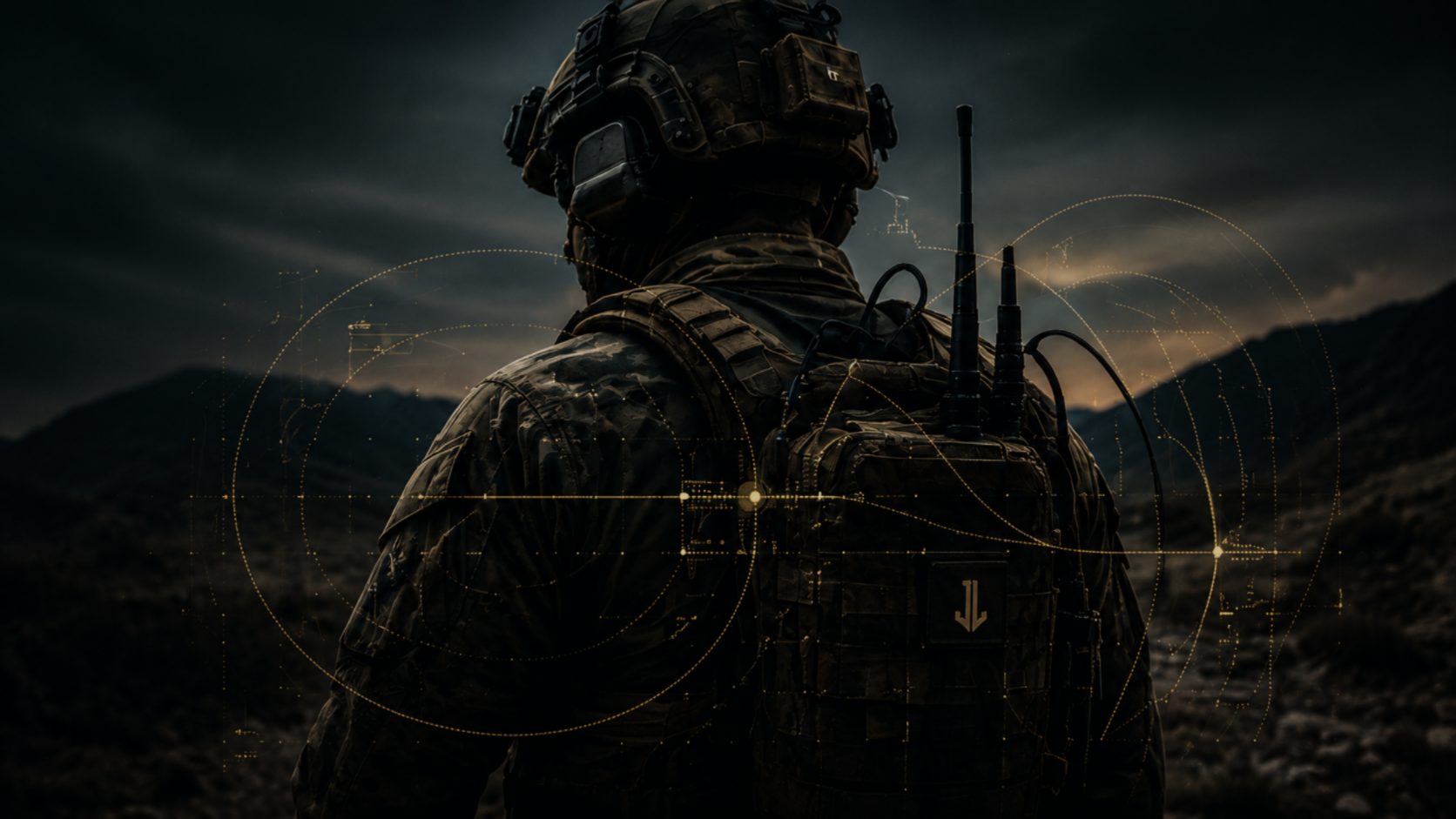
LOW-SIGNATURE
COMMUNICATIONS
ARCHITECTURE
FOR THE TACTICAL EDGE
Soldier-worn RF integration, distributed antenna systems,
and spectrum-aware design for real-world operational environments.
When the physical layer is stable, everything above it
becomes simpler, quieter, and more reliable.
THE PROBLEM
Most tactical networks do not fail from A lack of capability.
They fail because the physical layer becomes unstable.
In real-world conditions, the physics of RF, the human body, and movement create constant challenges that traditional systems are not designed to solve.
The human body absorbs and blocks RF

Movement constantly changes link geometry

Antenna placement creates inconsistent coverage

Systems compensate instead of solving the root problem

Those compensations costs




Power
Increased power consumption
PRocessing
Higher processing demand
Latency
Retransmissions and delay
Confidence
Reduced system effectiveness
Systems Architecture for the Tactical Edge
Low-Signature RF Integration
Body-worn RF integration and emission-control methodologies that reduce electromagnetic signature while sustaining mission-critical communications.
Soldier-Worn Network Design
System-level integration of radios, sensors, compute, and power into distributed edge—node communications architectures.
Program & Platform Advisory
Technical advisory support for PM offices and primes navigating C2 Modernization, Nett Warrior, and tactical radio alignment.

VEIL™
VEIL™ (Versatile Emissions-Invisible Link) is a patent-pending passive, body-integrated antenna system engineered to reshape RF emission behavior at the physical layer.
By implementing a distributed low-SWaP radiating topology across load-bearing equipment, it reduces localized RF concentration and external electromagnetic exposure while enabling short-range intra-operator connectivity. The distributed configuration reduces coverage shadowing and directional bias, promoting more reliable near-body RF connectivity around the operator.
Waveform-agnostic by design, the architecture integrates with existing radio platforms without requiring changes to operational software or hardware baselines

Focus Area
CURRENT ENGAGEMENT
Engaging with government
and industry partners on
low-signature, soldier-worn
communications architectures
during SOF Week 2026.
Available for short technical discussions
and capability alignment meetings.
Soldier-Worn
Wireless
Integration

Distributed
Antenna
Architectures

Low-Observable
RF Design
(LPI / LPD)

Tactical Edge
Systems
Integration

Spectrum-Aware
Network
Design

Operational Data
Transport
(Sensors)